Sunday, June 21, 2015

Father's Day


This past Christmas my son Matt, 21, gave me a photograph he had taken from one of his many adventures out west. With this photo was a simple note thanking me for sparking his interests in the outdoors at an early age. The note is proudly displayed in the caretaker’s cabin next to the framed photo of a moose. Great photo! Matt has become a talented photographer, but the note is what I cherish the most. Especially on Father’s Day.

For the past two summers Matt has worked, camped and hiked out west logging more than 600 trail miles as well as a summit of Grand Teton in Wyoming. He may have attributed his love for an outdoors lifestyle to me but it actually filtered down from my father, Jim Guenther. And for this I’m grateful. My own outdoor experiences began at an early age, just like my son’s.

I grew up in suburbia Nashville but moved to a wooded hillside in rural west Nashville by the time I was 14 years old. It became my outdoor playground. Endless acres of wooded hills, streams and a gorgeous valley.

Like many fathers, my dad was a busy man. His law firm demanded dedication but he always found time to take my sister and I on camping and canoe trips as well as hikes along the Appalachian Trail. The interesting thing about memories for children is that the simplest things often make the greatest memories. Fathers likely never realize what an impact they make in their children’s lives. My father held my hand and introduced me to the wonders of the outdoors.

On this Father’s Day, make an attempt to get off the couch and step outside with your children. It’s simple entertainment and no better way to discover an adventure. And if you are a father, it creates memories that last a lifetime.

Love you Dad!


Tuesday, April 7, 2015

Wildflower Photo Trek

With the arrival of spring I always look forward to our Annual Native Plant Sale. In the past I’ve tried to make my blog timely and offer suggestions for photographing spring’s wildflowers. My suggestions are simple and can often turn an ordinary photo into one you may wish to keep.

Just a few weeks ago my daughter Erin joined me for a wildflower hike. She is a junior at Signal Mountain Middle/High and a photographer for the school’s yearbook. With a shiny new Christmas camera she has discovered the joy of photography. Erin is naturally artistic but like most novices she needed a bit of technical knowledge to boost her confidence. F-stops & shutter speeds are often a foreign language until you begin to understand how the combination of the two along with lens choice has an effect on the final photo. And with wildflower photography, showing less often means more.  

So lets start with getting low and doing what I call the “belly crawl”. Wildflowers require an eye level perspective. My lens choice is a 55mm macro with an added extension tube for greater detail.  

As Erin and I walked along Reflection Lane she noticed just how tiny and delicate many wildflowers can be. She has never used a macro lens or an extension tube. With less depth of field focus is crucial. A tripod comes in handy allowing for slower shutter speeds and greater depth of field, but can be awkward to hike with and a nuisance on difficult terrain. On this particular day, slower shutter speeds were ineffective thanks to a steady wind. Hand held shots at 125th of a second or faster were a must. 

With macro lenses your background naturally drops out of focus. But one suggestion that I shared with Erin was to use a folded 16 x 20 inch or larger black foamboard behind your subject to create a more polished studio effect. I don’t suggest this in all cases, but it can often compliment your subject matter or make for a less distracting background. Simply position the board so the sun illuminates the flower and not the board. 

As Erin and I crawled and searched for the perfect rue anemone, bloodroot, star chickweed and trout lilies she quickly developed an appreciation for perfecting her shots. Composition, lighting and an unique angle are all so important. But one thing you often can’t control is the sunlight. I suggest sunny mornings or evenings. Some photographers prefer diffused lighting with overcast skies.

Wildflowers often peak and die back within a weeks time so don’t miss the chance to perfect your photographic skills. But if you would rather just purchase and plant wild flowers, check out our upcoming Spring Native Plant Sale this Thursday (members only), Friday and Saturday. Details are provided on our website at reflectionriding.org.


Wildflower photos by Erin Guenther


Monday, March 16, 2015

Winter Tree Identification

Need an outdoor winter challenge?  During a recent hike across Reflection Riding, my friends and I tried to hone our tree identification skills.  Bark, tree structure and perhaps a few clingy seed pods were all we had to work with.  The green leafy evidence is long gone.  Most of us can manage to identify the most common species of trees during the summer months but this day we struggled to make a definitive match.

Fortunately, several trees have distinguishing characteristics which proved to be helpful.  Bark can be smooth, rough, shaggy, snowy white or black. Since you too might be a novice, lets just focus on a few of the most easily identifiable.  

Consider the shagbark hickory. The bark is literally pealing away from the trunk like shingles from a rooftop. That’s an easy one.  Look in front of the caretaker’s cabin and you’ll see two to three persimmon trees.  The bark is black or gray and wraps the trunk with small square blocks.  Very distinguishing. 

A few trees even retain their leaves.  This characteristic is called Marcescent.

As we scan the horizon we notice a variety of oaks that fall within this category. The American Birch along Reflection Lane is holding onto brown leaves as well.  We walk on.  Next few steps we hesitate.  High in the canopy we spot seed pods silhouetted agains the gray sky.  Great clue!

If you see a tree trunk with perfect posture and seed pods resembling the petals of a flower you have identified a Tulip Poplar.  Next we see round spiky pods scattered across the forest floor. Above us is a sweet gum. 

As we walk along Lookout Creek, sycamores line the shoreline. Their bleached white bark offers the only contrast on this overcast day.  Soft round seed pods hang from their branches as if decorated for Christmas. 

Halfway up a wooded hillside we spot a long wispy seed pod. Someone suggests it’s a sourwood.  With a quick check of our tree guide we see an exact match. 

By now we have walked to the far end of the property.  In an open field we encounter one of the most unusual looking trees thus far.  Is it a black locust or a honey locust?  Clusters of 3 to 4 inch thorns along the trunk of the tree create a impenetrable armor.  Thin brown seed pods shaped like dehydrated bananas dangle from its branches.  When we get back we Google both.  It’s a honey locust.   

Here at Reflection Riding Arboretum & Nature Center we have more than 140 species of identified and labeled trees in our collection.  Download our arboretum map and tree guide to help you with your next visit.  http://reflectionriding.org/wp-content/uploads/2014/03/Arboretum-Map-for-Website.pdf


Thursday, January 29, 2015


Skunked!

As you know I often write about the beauty of living here in the Caretaker’s cabin surrounded by all sorts of wildlife. I’ve also written about my fascination and appreciation for skunks. Well, there is an upside to living in a wildlife preserve but a down side when it comes to frightened skunks.

About six weeks ago I discovered that there was at least one skunk that seemed to be living under the cabin. No big deal I thought. I would often see the white stripe illuminated by the moonlight walking around the back deck. A suspicious character indeed but never a threat. So I thought.

When I was a teenager I often trapped critters using a Havahart trap, a bait and release live animal trap. I often caught raccoons, possums, rabbits and even a box turtle. One time I had the misfortune of catching a skunk. What to do? My dad called a vet and he suggested that if the skunk was too large and cramped inside the trap he would not be able to spray unless he could raise his head and tail. Who knows if any of this was true but it was a plan. I’ll never forget the image of my dad running and hiding behind a tree once the trap door was opened. I had never seen my father run. We still laugh about it. And no one got sprayed.

Back to the cabin.

So soon after first spotting this underground cabin dweller, I arrived one night after dark and unlocked the back door. I immediately took two steps backwards and gasped. The cabin had been temporarily robbed of its charm. The air inside rushed out and surrounded me in a toxic cloud. The neighborly skunk had now overstayed its welcome. Apparently he or she had been under the cabin when this foul act occurred. The smell had found its way inside, creeping effortlessly through the vents and hardwood floors.

Fast forward to just four nights ago. Then repeat.

So, knowing our wildlife expert here at Reflection Riding, I questioned Wildlife Director Tish Gailmard on what I could do. Tish explained the rules with regard to trapping a wild animal with an emphasis on discouraging anyone from tackling such a job on their own.

Tish suggested that a professional trapper or “critter getter” would be the best response. “Skunks are a rabies vector species,” she said. “Hamilton County is a rabies vector surveillance county.” Meaning any trapped rabies vector species must be euthanized and tested. “What I suggest for individuals that have this problem is to contact a trapper that we recommend and let him handle it.” Sounds like sound advice.

Despite the recent incident, I’ll aways enjoy viewing the wildlife that passes by the big picture window at the Caretaker’s cabin. But this one restless skunk may need to go. My hope is that it moves on its own to a more suitable residence. And soon!


Tuesday, December 9, 2014

Persimmons


They dangle from the bare branches like tiny orange Christmas ornaments here in the caretaker’s cabin front yard.  The fruit shows up by mid summer and ripens by the end of October. By mid November the orange fruit turns purple and drops to the ground. Last fall the trees provided a constant source of entertainment, attracting deer and opossums nightly. So why are they being ignored this year?

From what I’ve read, if the acorn crop is hearty the deer are less interested in the persimmons. But where are all the opossums? I realize they have a very short life span, maybe 2 years, but this time last year I would always count on spotting 2 or more on a brief walk from the cabin’s front door. I’ve heard more coyotes this fall so perhaps they’ve simply been eliminated. Some reports are conflicting, suggesting that a coyote has a discriminating appetite when it comes to these defenseless slow moving marsupials and simply resists the temptation.

So, not to waste a natural food source, each year I collect a bag of ripened persimmons for our animal ambassadors living over in the Wildlife Wanderland.  And in the past, a few friends have tried to harvest the fruit. Some used bed sheets to catch the fruit with a gentle shake of the tree’s trunk.  The delicious mushy flesh of the persimmon makes great wine, beer, pudding, bread, cakes and jam. And lowers your cholesterol.

I really do miss the opossums and wish the deer had not gorged themselves on so many acorns. But there seems to be a few deer that still can’t resist. Perhaps they too have a sweet tooth!


Friday, November 14, 2014

An article about our resident caretaker and photographer, Jeff Guenther


Get Out Chattanooga Magazine discovered my blog  recently and asked to do a feature article about what it is like to be caretaker here at Reflection Riding Arboretum & Nature Center.  Below is a brief question and answer interview written by Mary Beth Torgerson that was published in this month’s issue.  Thanks Mary Beth!
Wilderness Retreat
A secluded cabin.  Waking up to the call of birdsong. Over 300 acres of wilderness at your doorstep. This may sound like a dream, but for Reflection Riding Arboretum & Nature Center Caretaker, Jeff Guenther, it’s a way of life. We sat down with Jeff to talk caretaker responsibilities and communing with nature.
How long have you been with the Reflection Riding Arboretum & Nature Center?
I moved here last March. I was a photojournalist for about 23 years, and on a hike while shooting some photos for a story, I met Jeffrey Hunter who was the former caretaker. He happened to mention that he was the caretaker, and he was leaving soon. I applied for the position, and I’ve been living here ever since. Being an outdoor enthusiast, it’s perfect for a guy like me. It’s been a really good fit, and I’d like to remain the caretaker for a long time.
What is a typical day like for a wilderness caretaker?
It’s really a role, not a job. The perk of the role is that I get to live in the caretaker’s cabin on more than 300 acres. There’s no golf courses and no pools — it’s just me after dark which is what I like. I make sure that my presence is felt here after hours. I usually patrol the property. If it’s before or after business hours, I’ll lock the gates or unlock gates to let folks in or out. I’m kind of the Andy Griffith of Reflection Riding. But what I do mostly is photography. I shoot pictures of most everything I see and provide pictures and videos for marketing materials and the website.
What kind of outdoor activities do you enjoy?
JG: One of the perks of being caretaker is that within 5 minutes, I can have my kayak in the creek. I enjoy paddling, taking my GPS and exploring smaller creeks. I’ve paddled about 11 miles from Lookout Creek down to the Nature Center. I do a lot of camping out of my kayak. I’ve always enjoyed hiking and backpacking, and I’m a recreational tree climber. Some people don’t get it, but I guess I’m an actual tree hugger.
Why should people visit the Reflection Riding Arboretum & Nature Center? What are some of the outdoor activities available there?
People don’t realize its proximity to downtown—you can be here in 10 minutes. It’s just at the base of Lookout Mountain, and it’s just as scenic as it can be. If you like paddling, there’s Lookout Creek. For hikers, there are 12 miles of hiking trails, some suitable for mountain biking, and that’s just the beginning because a whole lot of these trails link up to the trails on Lookout Mountain. You’ve also got the Wildlife Wanderland, which is where our animals like red wolves and a bobcat are on exhibit, and some great educational programs from staff for adults and children. There are some people who just don’t know we’re here, and that’s a shame. It’s a beautiful place. More people should come out and see what Reflection Riding has to offer.


Wednesday, October 15, 2014

Skunks, I Salute You!


No one ever says anything nice about skunks.  Remember the song “Dead Skunk” by Loudon Wainwright III?  Well no more.  I walked out the back door of the caretaker’s cabin one night this past week and stumbled upon one of the many skunks that make their homes here.  I had a head lamp on and was about to go for a night run when that dreaded white stripe caught my eye.  


I’ve photographed a few skunks during daylight hours, making sure that I’ve always respected their personal 15 foot rule, and they have always been quite accommodating.  But I never realized they were such helpful gardeners.


For the past few weeks I’ve been walking and mowing around a yellow jackets nest located between the cabin’s back door and my car. The hole in the ground was no larger than the width of my thumb but below was a land mine the size of a soccer ball just waiting to explode.  I’ve been stung multiple times this summer mowing the yard and despite the painful memories I’ve simply been too lazy to do anything about this most recent nest.  What had become a constant nuisance for me had now became a high protein snack for the skunk.  

Upon closer observation I discovered that this nocturnal visitor had dug down and found the nest leaving a 6 inch diameter hole revealing all that was left of the bees and their comfy little home.  From what I’ve read, skunks seem to be immune to the bee stings and prey on both the larvae and adults.  

So next time I’m driving and see a dead skunk in the middle of the road, rather than mocking him by humming the popular 70’s tune “dead skunk in the middle of the road, roll up your windows and hold your nose” I’ll simply salute.  I’d much rather endure the passing odor than be stung repeatedly by more yellow jackets.  Bring on the skunks!

Sunday, September 21, 2014

The Splendor of Fall


Things are about to change.  I typically walk or take a run through Reflection Riding daily and have noticed the forest seems to be in a transitional phase.  There seems to be a lull hanging over the forest as if the trees have already acknowledged that the days are getting shorter and they are within just a few weeks from slipping into the splendor of fall.  My favorite time of the year.

But summer hangs on.  As Joyce Stanbery mentioned recently in her blog “Woods and Wildflowers” the Pilewort and Asters are still blooming and the humming birds frequent the Jewelweed in front of the caretaker’s cabin.  But not for long. By mid to late October it all changes.

From Reflection Riding you will see a wave of colors drift down the slopes of Lookout Mountain until the whole valley shimmers in hues of gold, red, pink and orange. So why does this cycle occur?  Keep in mind I’m just a casual observer but here is a brief interpretation of what I’ve read. 

We’ve all heard of chlorophyll.  Well apparently it not only assists the tree with photosynthesis but it also masks the true pigment of the leaf during the summer months and is the reason for their green color.  Carotenoids and Anthocyanins, types of organelles in the plant cell, determines the color shift in the fall. 

As the days shorten, the trees slowly stop producing chlorophyll to conserve energy for the winter. During the fall months, the golden yellow or copper colors are the result of carotenoid pigments in the leaves. Anthocyanin pigments are responsible for the pink, red, and purple leaves.  These colors favor warm sunny days followed by cool nights.  A cold snap or cloudy days near the peak of season reduces their brilliance causing them to turn brown and fall more quickly. 

In my opinion, fall is one of Mother Nature’s premier events.  And if you have a yard to rake, just consider the extra work the price for admission. 


Thursday, July 31, 2014

Caretaker’s Cabin/Then and Now

This summer I decided to dress up the front of the caretaker’s cabin with a bit of color and warmth.  With a bit of advice from Paola Zannini Craddock, our greenhouse manager, I’ve got a simple but nice flower bed which I hope offers blooms throughout the summer months.

As I’ve learned more about the former caretaker’s that have lived here since the 1950s, I’d like to share a bit of what I’ve heard.  The cabin was built in the 1950s with logs harvested from the property here at the base of Lookout Mountain.  The cabin first served as the caretaker house when Harold and Marie Humphreys made Reflection Riding their home in 1958.  They were very close friends of the Chambliss family who founded Reflection Riding in 1956.  Here is a link to the history of the Humphreys House.  Click on http://chattanooganaturecenter.org/www/docs/138.464/  

I’ve posted a couple of historic photos, one showing John Chambliss standing out front and a black and white photo of ducks on the Upper Pond just across from the cabin. 

Caroline Hudson, granddaughter of Harold and Marie, tells me that throughout the years beautiful flower beds have often dominated the front yard.  There was even a small water feature where water pumped from the existing well house cascaded down a rock ledge which created a shallow pool before trickling into the creek below. 

If you walk past the caretaker’s cabin now the remains of the spring house are still evident, now capped with a rounded shingled roof.  I’ve seen photos made from the Humphreys House that include the caretaker’s cabin but have not see any that show the gardens or flowing spring.  It must have been quite beautiful during the summer months.

Although the former manicured gardens are only a fond memory, the front yard still becomes quite popular among visitors and photographers come August when the Goldenrod and Ironweed are in full bloom.  Hummingbirds can be seen daily darting back and forth like teeny tiny stunt pilots savoring the sweet nectar.  


With this summer’s addition of my modest flowering garden I can only imagine what it must have been like in it’s full glory.

Wednesday, July 16, 2014

Sunset Rock/A Historical Landmark

When you live at the base of the westward facing slope of Lookout Mountain Sunset Rock is always bearing down on you.  If you have never been there it’s one of my favorite vantage points for viewing Reflection Riding as well as downtown Chattanooga.

Hikers enjoy a recent sunset.
There are plenty of ways to get there.  For the more adventuresome souls, you can begin here at Reflection Riding and use one of our maps to make your way up. It’s a tangled web of trails and old forest roads and takes the average hiker a little over an hour to reach the top.  

When I first became caretaker here at Reflection Riding one of my exercise routines was to walk/jog up Lookout Mountain timing myself each time to the summit.  I’m hardly a trail runner, but I was able to shave 5 minutes off my first attempt and have gotten it down to a respectable 32 minutes.  A self prescribed stress test.  No deductible or copay required. 

Sunset Rock has always been a natural landmark but during the civil war soldiers used it as a vantage point for communication.  A soldier could signal from what is now Candy Flats here at Reflection Riding to another soldier perched atop Sunset Rock.  A horseman would then ride with the decoded message to what is now Point Park where the Battle Above the Clouds was being fought.  It was November of 1863.  Flags were used to signal soldiers during the daylight hours and torches were used at night.  I’ve posted a photo of a civil war reenactor illustrating this technique here on the property last year during the 150th anniversary of the Battle of Lookout Mountain.
A Civil War reenactor signals toward Sunset Rock

I often patrol the property after hours and I always carry a flashlight for security if needed.  Lots of “wildlife” to monitor here at Reflection Riding.  My flashlight is advertised as tactical, holster included, for obvious reasons.  Some might say the brightness could stop a train. 


So, on occasion I too have signaled towards Sunset Rock.  With a series of quick flashes, I’m often able to attract the attention of late night hikers or couples lingering in the romantic twilight.  Oftentimes the signal is repeated back towards me as if we were communicating in morse code.  


I see you. Do you see me?  No special decoding required. 
View of Reflection Riding Arboretum & Nature Center
from Sunset Rock.

Friday, June 27, 2014

Raspberry Treat

One interesting thing about the property surrounding the caretaker’s cabin is the variety of edible fruits and berries.  If you have ever walked by during the fall months, you may have noticed that there are 3 persimmon trees scattered along the perimeter of the front yard.  

After the first frost and long after the leaves fall the fruit hangs on the bare branches like tiny orange weights ripe for the picking.  The deer and possums can be spotted nightly gorging themselves on the tart fruit.

Another rare treat which I have yet to learn how to make use of is the fig tree that has been the dominate plant growing just to the left of the cabin’s front door.  Sadly, this past winter’s severe temperatures damaged the tree and it had to be cut back, but new sprouts have sprung and it seems to have recovered nicely.  Perhaps it too will produce fruit again and I can find creative ways to garnish a meal or simply use them as a pizza topping.

In the back yard, there is a cluster of raspberry bushes. I noticed them last year as I mowed around them but never really thought about eating them.  This past week I picked enough to fill a large plastic container and have added them to my morning’s oatmeal.


As I was writing this blog I researched the benefits of raspberries and found that they not only taste great but also offer anti-cancer and anti-aging properties.  What a treat!  And with another birthday bearing down on me at the end of this month, the timing could not be better.  Bon appetit!

Tuesday, June 24, 2014

Pepe’ Le Pew

I often brag to my friends about the wildlife that I get to see almost daily here at Reflection Riding, especially in the evenings.  Over the past year it’s been interesting to witness the cycle of the critters that come and go with the seasons.

In the winter months the deer are everywhere from dusk till dawn.  The turkeys which feed in the fields during the warmer months and are as common as your suburban neighborhood dogs, seem to disappear into the forest soon after the leaves begin to fall.  The possums, they don’t hibernate, seem to fill a gap in the colder months and are often spotted throughout the reserve darting unconsciously in and out of my car’s headlamps as I drive the loop road.  But it seems that I see them less often now, replaced by the “polecat” or skunks.  Skunks have few predators so most carnivores honor their personal space which is commonly known in the forest as the “10 foot rule”.  Strangely enough, Great Horned Owls which have a poor sense of smell often prey on these unlikely targets.

Skunks are typically nocturnal creatures which forage for insects, worms, eggs and rodents.  From what I’ve witnessed, one of their favorite appetizers are yellow jacket wasps.   The caretaker’s back yard is riddled with small earthy pot holes where the skunks forage for this tasty treat.  I’ve often been awakened by the pungent smell that somehow creeps through the thick log exterior of the caretaker’s cabin.  Albeit part of the cabin’s personality and charm is it’s simplistic and somewhat minimalistic architectural design but it’s quite the rude awakening.


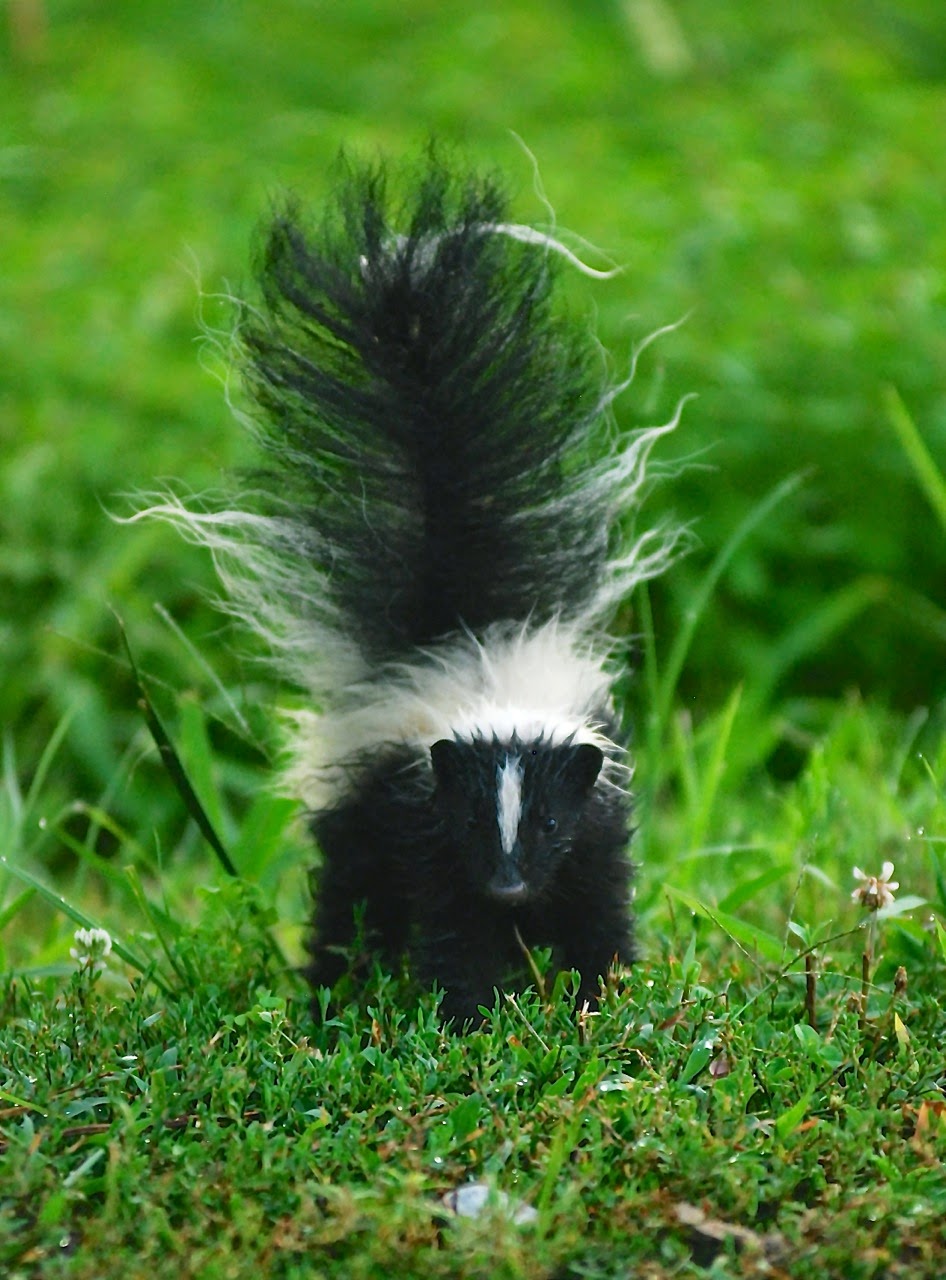
The picture I’ve posted was taken last June in front of the Humphreys House.  Even though the yellow jackets swarmed, determined to drive this young skunk from their nest, the stings could not penetrate the skunk’s coarse fur.  I made this picture using an 80-200mm lens from about 15 feet away.  Close enough to hear the crunching sounds of the defending wasps final defense, but on the outer edge of the skunk’s target range which is reported to be about 10 feet.  Give or take a few inches.

Wednesday, May 28, 2014

Turkey Cam

For the past couple of weeks I’ve had a hen frequent my bird feeder here at the caretaker’s cabin.  The squirrels and and an occasional raccoon scatter the sunflower seeds creating an ideal opportunity for turkeys to gobble up the leftovers.

This one particular hen has become a welcomed companion and seems quite comfortable with me watching from the back porch.  So, one rainy weekend I decided to mount my GoPro camera near the feeder with hopes of capturing some video to share with you.  With a bit of patience she did return.  She is typically alone but had now attracted a suitor.  You can view a short video clip at http://youtu.be/t_q7ywdR64o

The Toms, the male turkeys, are in full blown courtship mode from mid March through June strutting about like Mick Jagger with a touch of Elton John’s flamboyance.  Their awkward courtship can’t help but remind me of those high school dances we all attended.  Remember how the girls and guys stood on opposite sides of the gym and pretended not to notice each other?

As I watched this Tom get closer I really felt sorry for him. Despite his chivalry, the hen just never seemed to notice.  Sunflower seeds seemed to be her only concern.


Perhaps he’ll eventually win her affection but it’s tough out there.  Reflection Riding seems to have its fair share of Toms.  I have spotted a few chicks lately, or poults as they are called, so love is definitely in the air.  Perhaps one day soon she’ll return to the backyard with her offspring in tow.  Tom turkey is welcomed too!

Sunday, May 11, 2014

Magical Forest

On Saturday, the 3rd of May, I decided to document the growth of bamboo.  One of our more memorable features here at Reflection Riding, especially among children, is our Bamboo Forest. The giant cane creates an enchanted forest. Invasive yes, but a magical structure that peaks the curiosity of visitors of all ages.
So how fast does it really grow? Bamboo is one of the fastest growing plants on earth.  There are over 1,000 species of bamboo with some capable of growing 3 feet a day and over 130 feet tall.  And how does our bamboo here at Reflection Riding compare? 


In the photos that I’ve posted, you can see the progression over a 5 day period (I’ve recorded the date of photo on the mature bamboo to the right).  The average growth measured out to be a little over a foot a day.  A remarkable feat worth checking out the next time you visit.  And if you use your imagination you too can witness it’s magic.


Tuesday, May 6, 2014

River Otter/ A Rare Sight

This past weekend I joined the Tennessee Ornithological Society on a bird walk here at Reflection Riding.  Migratory birds pass through this area, some traveling 1,000 miles or more to reach their summer homes.

As Kevin Calhoon, our tour guide and the Tennessee Aquarium's assistant curator of forests, led us towards Lookout Creek along the boardwalk someone shouted, “look it’s an otter”.  To everyone’s surprise about 30 yards away, sunbathing on a log was a young River Otter. 

About 4 months ago, I was paddling near the center’s canoe launch and observed a similar critter diving beneath the water.  We have plenty of beavers and muskrats but few have seen an otter along the creek.  I guess now I’m more confident about what I witnessed.  Perhaps it was this little guy or a member of his family.  


Our “Waking Up With The Birds” walk is definitely worth attending this Saturday at 7:30 am, but this little otter stole the show that day.  

Wednesday, April 23, 2014

Belly Crawl: A Photographer’s Perspective

Blue-eyed Marys along Susan's Path at Olmstead Outlook
Shooting Star at Wildflower Cove
There is a very narrow window each spring in which you can catch this season’s true glory.  And much of it happens just a few inches above the forest floor. 

Ephemeral wildflowers, the first to grace the winter’s barren landscape, are often short lived. Bloodroot, Cut-leaved Toothwort and Trout Lily emerge in early April and are all gone by May. 


Bloodroot
As I crawl with my camera just a few inches above the forest floor the cycle is clear.  This small group of wildflowers time their emergence while temperatures are still cool and long before the forest canopy blocks out an essential ingredient to their survival.  The sun.
Toothwort

I first began photographing many of our wildflowers just 3 weeks ago before any of the trees had sprouted their leaves.  Many have now faded or disappeared.  The Mayapple, which have just begun to bloom, now spread across the forest floor like tiny umbrellas blocking out more of the precious sunlight.  If you are familiar with the large patch of Virginia Bluebells that grow throughout Oliver Freeman’s Hollow, this has become quite evident in recent days. And the cycle continues.


Virginia Bluebells at Oliver Freeman's Hollow
Even though the Boodroot and the Toothwort have faded, the Shooting Star (look along the trail at Wildflower Cove) and Blue-eyed Marys (look along Susan’s Path at Olmstead Outlook) are now taking center stage.  Come see us!  Belly crawl is optional!